
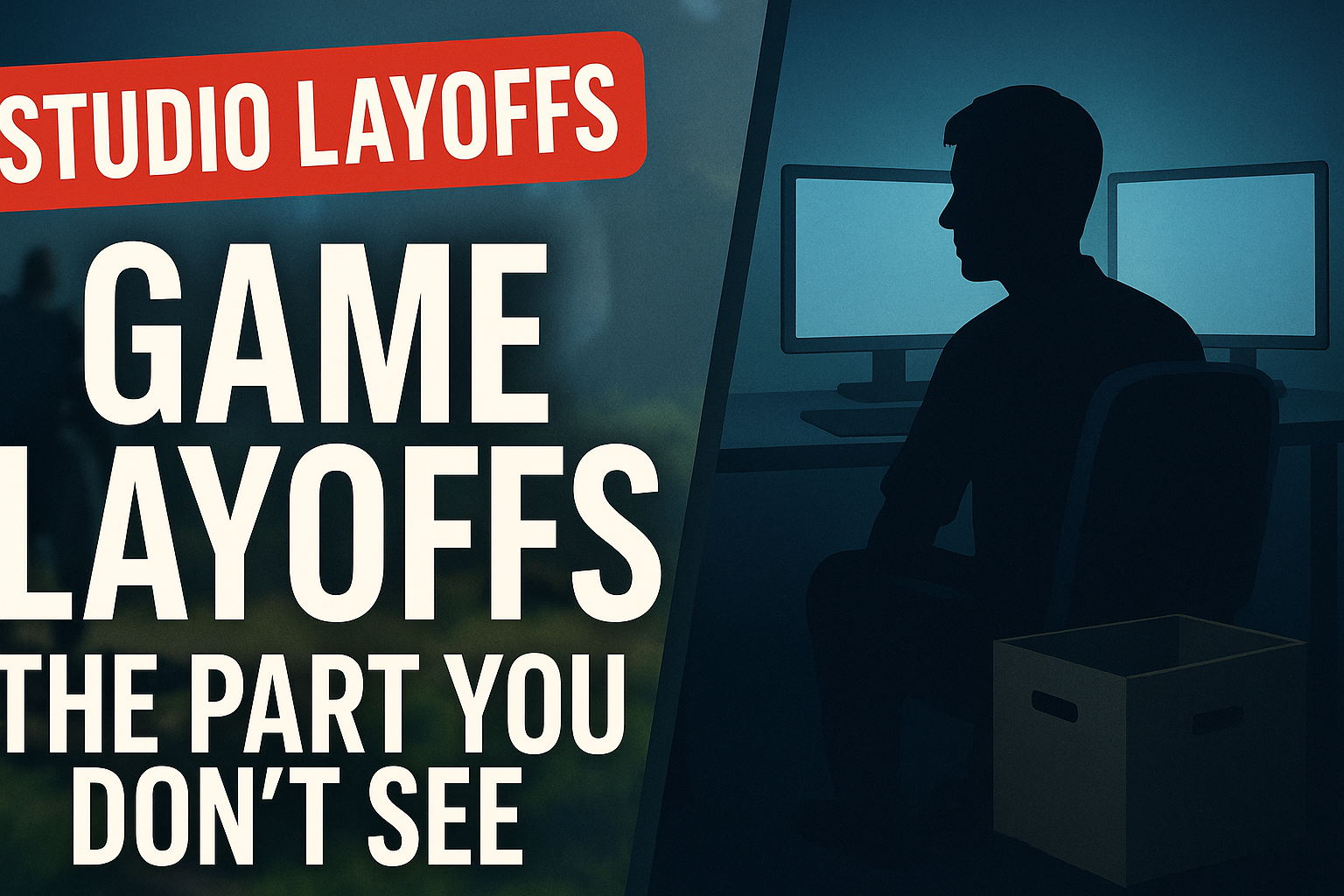
Game Layoffs Aren’t a Plot Twist – They’re the Business Model
You know this story.
A studio ships a long-awaited game. The reviews are good, social feeds are full of reviews, guides, and walkthroughs, and the reward is the game tops sales charts for a couple of weeks. Then, almost on cue, another headline drops: “Studio lays off 380 workers.”
The outrage is instantaneous. How can a “successful” game end with people losing their jobs? Isn’t that proof the company is greedy, broken, or both?
It might be proof of a lot of things. But many times, it’s proof of something much more mundane: games are made like movies, not like traditional office software, and we keep pretending otherwise.
It’s time to realize that game production staffs are more like movie production. They Staff, then theyWrap
We talk about game jobs as if they’re normal tech jobs attached to a permanent product line. They’re not. Structurally, they look a lot closer to film and TV.
A movie producer raises money, hires a cast and crew for a specific production, shoots for months, then lets most of those people go when the film wraps. The project has a life cycle and so does the staff.
Game development runs on the same rhythm. A small pre-production team prototypes ideas, builds tools, and figures out what the game actually is. As the project moves into full production, the headcount explodes: engineers, environment artists, character modelers, animators, writers, along with a myriad of other jobs.
Then when the game ships—or when a game is canceled—that balloon of production jobs doesn’t all roll neatly into the next thing. Some do. Many don’t.
So when a studio cuts staff after launch, it’s often doing what movie studios do after the last shot: ending roles that only ever existed for that production. You don’t have to like that reality, but you can’t analyze the industry honestly if you ignore it.
The gaming public likes to yell, “But There Are So Many Layoffs. Doesn’t That Prove Greed?”
Not always.
The last few years have been brutal. Game layoffs have come in waves, on top of broader tech layoffs and a post-pandemic correction where companies quietly admitted they over-hired.
Don’t get me wrong, there is a healthy bit of greed and terrible judgment in there as well. Companies have a bad habit of chasing every live-service trend, stacking up acquisitions, betting on platforms that never materialize. When those bets go bad, workers pay the bill.
But “a lot of layoffs” doesn’t automatically equal “everyone at the top is cackling over a pile of money.” Sometimes it just means the studio staffed to a peak it would never sustain. They hear the public screaming and make a mad dash to hit a date and then burn resources and time for that “just one more feature.”
You should absolutely be angry about specific choices: frantic overexpansion, impossible schedules, projects green-lit without a believable plan. Just don’t morph every cut into the same cartoon-villain story. If “layoffs exist” is all it takes to prove evil, then every industry on earth is evil by design.
There is this belief that Devs are one big family, and yes they probably are for the length of the project but then reality kicks in and we learn they are more like film crews.
Gamers want to imagine dev teams as fixed, a cozy family living inside one studio for decades. A more realistic comparison would be they are closer to actors, writers, and crew who move from show to show.
In film and TV, people build careers out of a string of temporary gigs. Unions, contracts, and benefits are built with that in mind. Your protections follow you from production to production; they don’t depend on a single set staying alive forever.
Games quietly operate this way already, especially in roles that swell during production. The difference is that our language hasn’t caught up. We still talk like every name in the credits is supposed to be a lifetime hire.
That mismatch between how the work actually functions and how we emotionally frame it is a big part of why every new layoff announcement feels like a personal betrayal.
Now here’s the irony: if you are going to treat devs like crews, you’re usually better off keeping the same crew together from project to project. Once a team has shipped a game, they’ve already fought through the politics, figured out who can’t stand meetings before 10 a.m., built their internal shorthand, and learned how to ship under pressure without murdering each other. Throwing that away every time the credits roll is expensive. You lose institutional memory, hard-earned workflows, and all the tiny social shortcuts that make production move faster. Even if not everyone can stay, studios that treat existing teams as the first draft of the next team will always move smoother than the ones that start from scratch every time.
If project-based staffing is so “normal,” why do game layoffs feel uniquely awful?
First, is visibility. You interact with game developers online. You see their faces in dev diaries, follow them on social media, hear them speak at conventions. When they’re cut, you’re not reading about anonymous “headcount reductions.” You’re watching a person you know lose their job.
Second is timing. A lot of cuts land right after a visible “win”: a hit launch, a big milestone, a major patch. Hearing them say one day “Our game sold great!” shortly followed by “we’re letting people go” feels like whiplash. It may be the inevitable shift from full production to live-ops staffing, but it looks and feels like betrayal.
Third, and probably most importantly, the gaming industry has no safety nets. Film and TV workers have spent decades organizing into structures that recognize project-based work: portable benefits, residuals, negotiated minimums, clear job categories. Games are just stepping onto that path. The underlying pattern is similar; but the protections are not.
So yes, it feels worse. In many ways, it is worse. Not because the idea of ramp-up/ramp-down staffing is uniquely evil, but because the surrounding supports are underdeveloped while expectations remain naïve.
There’s another unglamorous angle most people ignore: the law already treats big layoffs as a thing that happens regularly.
In places like the U.S., rules like the WARN Act and state-level equivalents require advance notice (or pay in lieu) once cuts pass certain thresholds. The reason these laws exist is that legislators accept a basic fact: large employers will add and shed workers over time.
But you can’t fix that reality with rage threads and hate threats. What you can influence is how those cuts happen—how much warning people get, how much support goes with them, and whether the workers themselves have any organized leverage when the conversation starts.
If you actually care about the people making games, then there’s a more useful fight than “never lay anyone off again.”
Push for studios to plan like professionals, not gamblers. That means building multi-project roadmaps so that when one game finishes, people can roll onto the next instead of falling off a cliff. It means being honest about which roles are truly temporary and writing contracts that say so up front, instead of pretending everyone is permanent until the day a security guard walks them out.
Push for real internal mobility and re-skilling. Plenty of people who crunch through a content spike could transition into tools, engine work, live-ops, or DLC if studios planned for that from the start instead of treating layoffs as the default post-launch cleanup.
And yes, push for unionization and portable benefits where it makes sense. If game work is going to look like film and TV in all the ways that hurt, it should also look like film and TV in the ways that protect.
It’s time for the public to grow up about how games get made. With that being said I assure you none of this is an apology for every bone-headed corporate decision. Some layoffs are absolutely the fallout from arrogance and stupidity. Some executives will always hide behind “market conditions” when what they really mean is “we lit our budget on fire.”
But if we want better outcomes, we have to start from reality.
Games are made in waves. Teams expand, peak, and contract. Jobs tied to that peak won’t last forever, no matter how much you love the art those people created. The moral question isn’t “did jobs end?” It’s “did the studio act responsibly, plan well, and treat people decently when the project’s needs changed?”
If you’re going to burn your outrage, burn it there—on the planning, the honesty, and the safety nets. Not on the basic, uncomfortable fact that your favorite worlds are built by crews who, like movie crews, don’t live on the same set forever.
